
- Published on ·
- Time to read
- 7 minute read
Building a House with Claude: Part 1

- Authors

- Name
- Patrick Hulce
- @patrickhulce
We're building a house! I've been daydreaming about it off and on for a few years now, and we've finally talked ourselves into it.
One small thing I'm actually excited about amidst the otherwise hellish start to 2026: vibecoding has made it practical to build absurd, one-off tools to reap even the most minor of benefits.
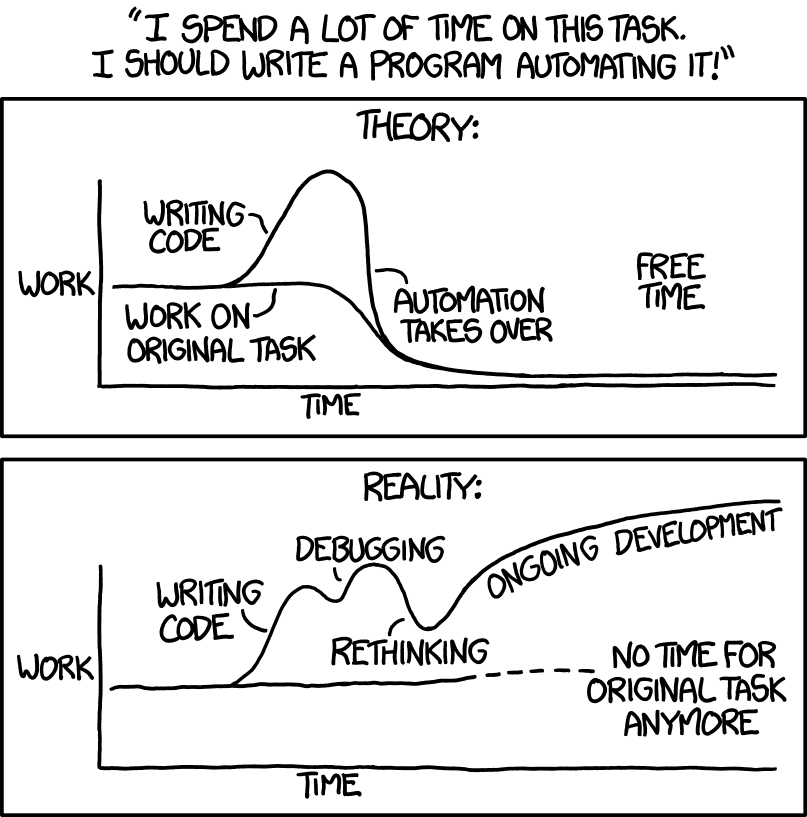
What the ROI for one-off tools used to look like in ye olden times 😂
So, I'm going to try my best to chronicle all the little tools I find genuinely useful in our house-building saga into a not-so-subtly-titled post series Building A House With Claude.
First up for today, the mother of all real estate decisions: where should we actually live?
Location, Location, and Also Location
The oldest cliche in real estate is, like most cliches, a cliche because it's annoyingly true. Where you live leaks into a disturbingly large percentage of your daily life. Your commute, your kids' schools, how long it takes to grab a rotisserie chicken from Costco at 6pm, whether seeing your in-laws is a "drop by just because" or "welp there goes that day" sort of thing. It's no small decision. Now, before you get too excited about our candidate locations, I need to set some expectations because our family is boring, like unapologetically suburbia-loving boring. If you're visiting this page from one of the coasts hoping for a breakdown of hip walkable neighborhoods with a wine bar around the corner, you've got another thing coming. Might as well close the tab now. Instead, we'll be targeting a yard the size of Texas, a three NO four-car garage, and a Costco storage room the size of...well an actual Costco.
In this suburbia-land, we really only cared about a handful of things:
- Vibes. Unscientific, unquantifiable. You know it when you see it.
- Schools. We've got three kids. With all this vibe coding progress, y'all know I'll need their help when I'm out of a job 😂
- Land availability. We want enough dirt to actually build the thing we're dreaming about and for aforementioned kids to run around a bit.
- Travel times. The daily and weekly grind of actually getting places.
Using our gut instinct and knowledge from living in Texas 8 years, we narrowed the whole sprawling Dallas–Fort Worth Metroplex down to basically four areas:
- Southlake
- Plano
- Frisco
- Flower Mound
Four solid suburbs, all passing our vibes-schools-land sniff test (Plano not really passing land, but reno was an option).
But distance, y'all...Distance to which thing? At what time of day? On which day of the week? With traffic, or in the fantasy world where DNT is empty? How does a teardown lot on Dove Road stack up against a reno in Timarron after you actually count up a normal week of driving?
You can answer this manually. I tried of course. Ya open Google Maps, type in an address, set a departure time, paste the result into a spreadsheet, and then repeat roughly 20 times per candidate house. And every time my wife texts me a new Redfin listing, the whole rigamarole starts over. And that is exactly the kind of stupid, repetitive problem that deserves an absurdly specific tool.
Doesn't This Exist Already?
You might be thinking, "Patrick, every listing site already shows commute times. You have agents that can use any kind of APIs. Just use those." Of course I did!
The estimates on the big real estate sites are, to put it in the most professional terminology I can muster, "complete shit." I should know, I worked on them 😅. They're usually a single optimistic number to "The Office" computed at the most optimistic possible commute time. They are nowhere near comprehensive enough to capture how many hours I'm going to realistically be spending in the minivan.
What I actually wanted was the full picture. Given a lot, tell me the realistic driving time to every place we genuinely go in a typical week:
- The nearest Target
- The nearest Costco
- The schools
- The zoo
- The nearest Panda Express
- My wife's office
- The nearest music lessons
- The nearest swim lessons
And critically, not just to those places, but to those places at the times we'd actually be driving to them. Costco at 10am on a Saturday is a very different drive than Costco at 5pm on a Tuesday. My wife's office at 8am on a Friday is the whole different ballgame from Tues-Thurs. Single numbers fail to capture all of it.
Drive Time Analyzer Enters the Chat
Our solution to this silly problem is a single self-contained drivetime-analyzer.html file, no framework bullshit, just the good old-fashioned HTML/CSS/JS trifecta. You give it your Google Maps API key in the URL, and you're off to the races.
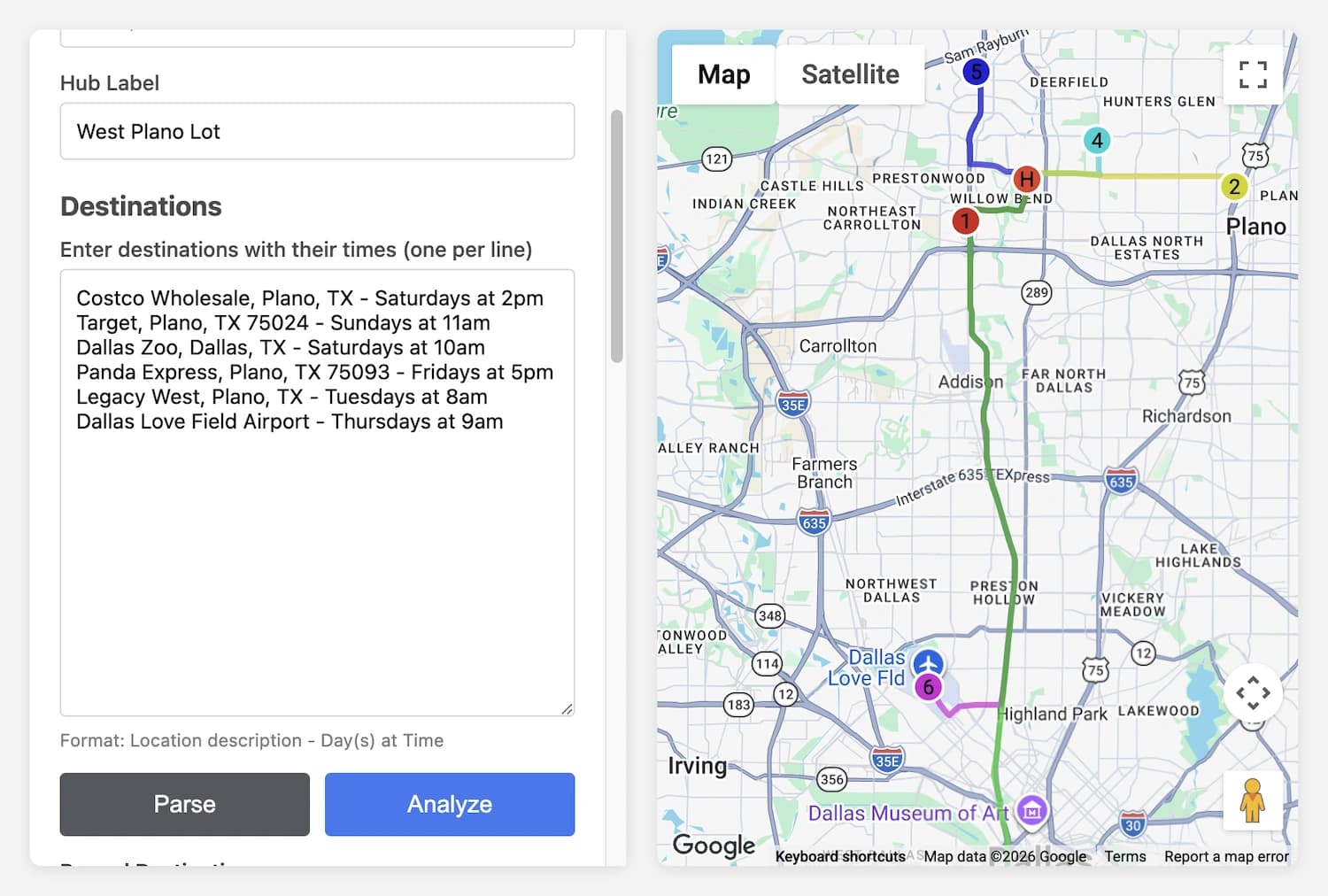
You type in a "hub" address (your candidate house/lot), then a free-text list of destinations, one per line, in a Location - Day(s) at Time format. Like so:
Costco Wholesale, Plano, TX - Saturdays at 2pm
Target, Plano, TX 75024 - Sundays at 11am
Dallas Zoo, Dallas, TX - Saturdays at 10am
Panda Express, Plano, TX 75093 - Fridays at 5pm
Legacy West, Plano, TX - Tuesdays at 8am
Dallas Love Field Airport - Thursdays at 9am
You hit Parse, and followed by a quick review before Analyze and ba-BOOM!
The Kicker: Traffic Sampling
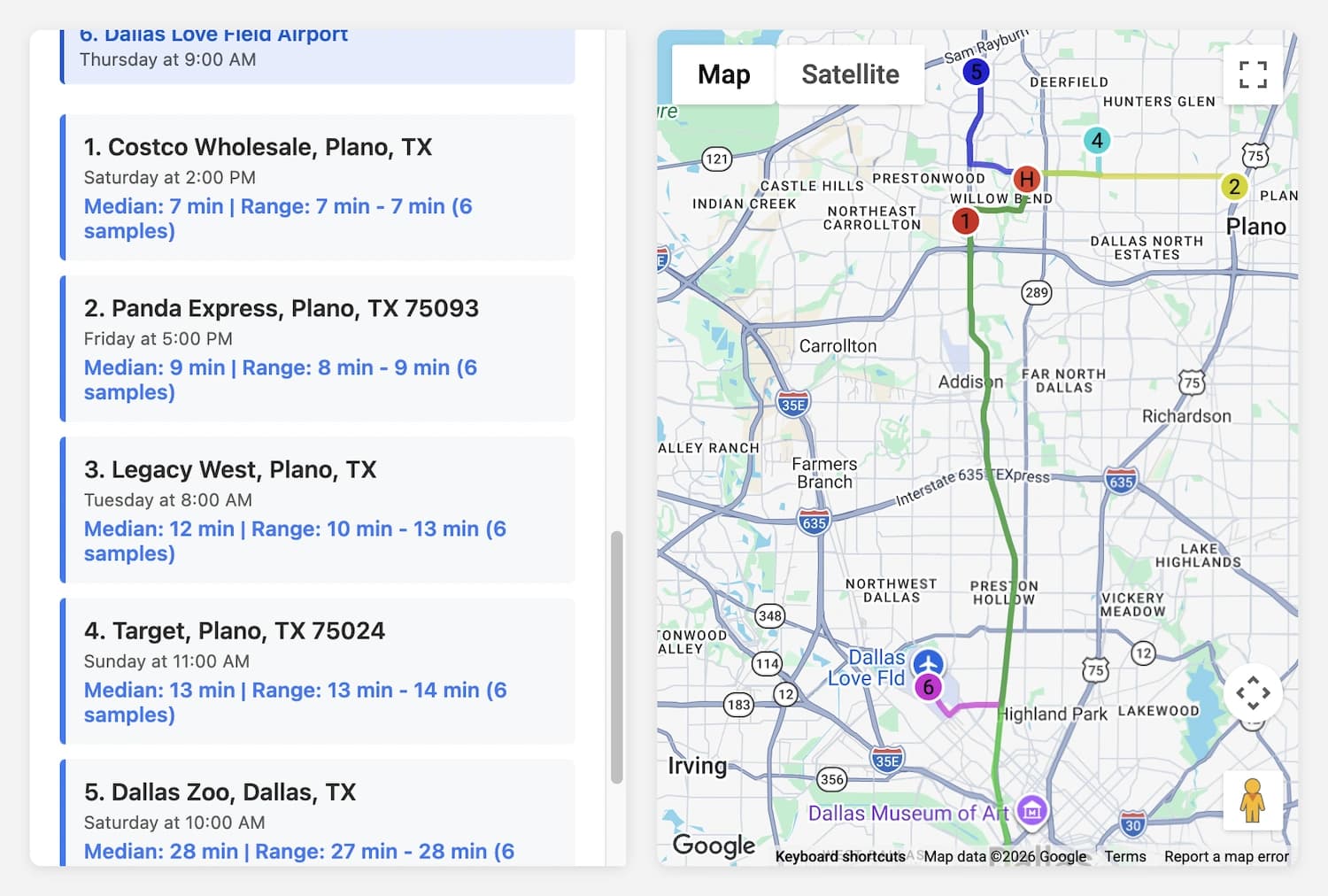
The app leans on Google's Distance Matrix API rather than raw directions, and crucially, it asks for traffic-aware estimates by passing a jittered departure time. This way we end up with a nice min/max/median range set instead of a single number.
Running it yourself
If you want to poke at it, the whole thing is open source of course. Not that this means much anymore in the agentic world. Running it locally does involve a tiny start.sh that boots a static server and opens your browser with the API key since we can't get Maps callbacks over the file:// protocol, but about as simple as it gets.
Early Thoughts
It took maybe an hour to get Claude to generate this and iterate it to the point where it did what I wanted. One hour to replace what used to be an hour of soul-crushing Maps-and-spreadsheet labor per address is a pretty fair trade.
Some notes for my future self:
Build the tool you actually need, not the one that's well-built
I built one ugly HTML file that does one thing. The bar for "worth building" has dropped through the floor, and the right scope for a personal problem is usually way smaller than your engineer brain has been trained to think it is.
Throwaway is not the same as wasted
We'll use this for a few weeks while we close in on a decision, and then we'll never open it again. And that is completely, totally okay. The tool already paid for itself the first afternoon. Disposable tools are allowed to be disposable. Let go of the guilt of not "productionizing" everything.
So there you have it: tool number one in the Building A House With Claude saga, in the books. We've got our four suburbs, we've got a way to actually compare addresses in seconds instead of hours, and my wife can now throw listings at me as much as she likes.
As for which of Southlake, Plano, and Flower Mound actually won the great drive-time bake-off, and what we decided to do about it? Well. You're gonna have to wait until the next post to find out. 😁